Hamberger Font: A Practical Embroidery Designer’s Real-World Review
Let’s cut to the chase: I pulled Hamberger Font into my embroidery workflow last week to finalize a custom line of minimalist linen tea towels for a local boutique. Not as a test run—but as a live project, with deadlines, client expectations, and real fabric under the needle. That’s where this review comes from—not a studio vacuum, but a working embroidery designer’s bench, stitch counter open, hoop clamped, and stabilizer already half-burned through.
First Impression: Clean, Friendly, and Quietly Confident
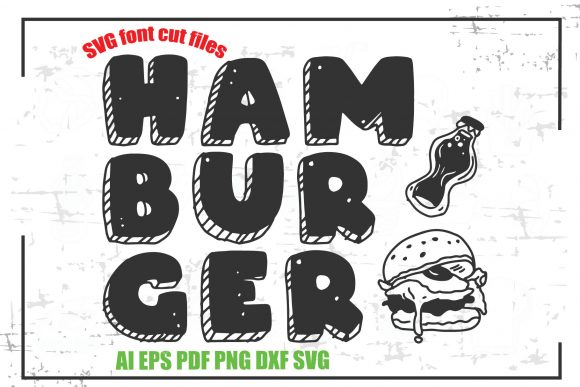
Hamberger Font doesn’t shout. It leans in—soft curves, balanced weight, subtle rounded terminals, and generous letter spacing that breathes even at 1.25" height. It’s not playful like a cartoon font, nor rigid like a technical monospace. It sits comfortably between modern craft and timeless handmade charm. The lowercase “a” and “g” have gentle double-story shapes; the uppercase “R” has just enough leg to avoid stiffness. As a machine embroidery design, it feels intentional—not traced, not over-digitized, not fighting the stitch medium.
This isn’t a font built for dense fill-stitch logos or aggressive branding. It’s made for the quiet confidence of a hand-stitched label on a baby onesie, the understated elegance of a monogrammed apron pocket, or the warm familiarity of a holiday embroidery kit stitched by someone who hasn’t touched a hoop since Grandma’s attic.
Where Hamberger Font Shines (and Where It Needs Care)
I ran it across six real-world applications—tote bag front panels, sweatshirt chest placements, cotton tea towels, baby bodysuits, embroidered patches, and kitchen towel hems—and here’s what held up:
- Tote bags & tea towels: Perfect. The clean lines translate beautifully in satin stitch outlines and light fill-stitch letters. No crowding, no thread piling—even at 2.5" width, stitch density stays even and legible after washing.
- Sweatshirts & baby bodysuits: Works best when sized 1.75"–2.25". Smaller than that, the inner counters (like the hole in “e” or “o”) risk filling in on textured fleece or brushed cotton. Always pair with medium-cutaway stabilizer and a sharp 75/11 needle.
- Embroidered patches: Excellent candidate. The consistent stroke weight and open spacing prevent fraying at edges during peel-and-stick backing application. I stitched it on twill-backed twill—and every letter stayed crisp after heat-sealing.
- Caps & curved surfaces: Use caution. The baseline isn’t overly flexible, so tight curves distort spacing. I’d recommend using only single words (not full phrases) and avoiding the back curve of structured caps unless you’re willing to manually adjust letter kerning in your embroidery software.
Fabric & Function Notes You’ll Actually Need
Hamberger Font behaves predictably—but only if you respect its sweet spot. On thin or stretchy fabrics (think lightweight jersey or bamboo knits), reduce stitch density by 10–15% and add tear-away + wash-away stabilizer combo. On dark fabric, avoid white thread unless you’ve tested opacity—some lighter-weight fills can ghost through. And yes, it works on linen—but skip the heavy fill; opt for satin-outline + light fill or running-stitch variants for breathable texture.
One thing stood out: Hamberger Font’s element files (17 total, including numbers and full alphabet) are truly separated—not layered or grouped. That means swapping “A” for “B” mid-project is fast, and building monograms or date stamps feels intuitive. For Etsy sellers bundling personalized gifts, that saves real time.
What This Means for Your Craft Business
If you sell handmade products or digital embroidery files, Hamberger Font adds quiet professionalism without demanding attention. Customers don’t say, “Wow, what a bold font!”—they say, “This feels like something made just for me.” That’s gold for personalized gifts, nursery decor, wedding favors, and small shop merchandise where warmth and authenticity matter more than flash.
It also scales cleanly into printable mockups. The SVG and PDF files render crisply at any size, making it easy to show clients how their name will look on a pillow cover or holiday ornament—no pixelation, no guesswork. And because it’s offered as both vector (SVG, EPS, DXF) and raster (PNG), you can drop it into Canva for social previews *or* import directly into Wilcom, Embrilliance, or Brother PE-Design without conversion headaches.
Designer-to-Designer Notes Before You Stitch
Before you load Hamberger Font into your machine or list it in your Etsy shop:
- Test on scrap fabric *exactly like your final project*—same weave, same stretch, same dye lot.
- Check contrast: try your thread colors against both light and dark fabric swatches before stitching the final piece.
- Review stitch density in your software—especially on letters with enclosed counters (“a”, “e”, “o”, “g”). Overfilling here causes puckering.
- Confirm hoop size compatibility. While the files are scalable, some elements may exceed standard 4x4 hoops when enlarged beyond 3".
- Inspect corners and terminals closely in your preview window—look for stray stitches or abrupt stops that could snag during wear.
- Run black-and-white mockups first. If it reads clearly without color, you’ve got strong visual hierarchy.
- Verify licensing terms before selling finished items or bundling Hamberger Font into your own digital product. It’s listed as a Graphics file—but commercial use rights aren’t implied unless stated.
The Bottom Line for Makers Who Ship Real Work
Hamberger Font won’t replace your go-to script for wedding invitations or your bold block font for festival merch. But it *will* become the quiet workhorse in your embroidery project toolkit—the one you reach for when you need clarity, calm, and craft integrity. It supports the handmade product without overshadowing it. It elevates a simple tote bag into something thoughtful. It makes a baby embroidery feel tender, not trendy.
For craft business owners, Etsy sellers, and small shop creators, that consistency matters. It builds trust—not through loud design, but through reliable execution. And in embroidery, where every stitch is visible and every wash tests durability, reliability isn’t a bonus. It’s the foundation.
If you’re evaluating Hamberger Font for your next batch of custom apparel, holiday embroidery, or digital design assets—go ahead and download the files. Then do what I did: stitch it on something real, hold it up to natural light, and ask, “Does this feel like the kind of thing I’d proudly put my name on?” With Hamberger Font, the answer—nine times out of ten—is yes.