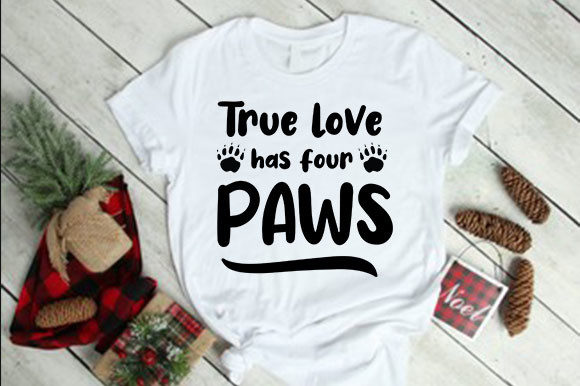
True Love Has Four Paws
A Designer’s First Look: Warm, Clean, and Instantly Recognizable
When I opened True Love Has Four Paws, my first thought wasn’t about file formats or licensing—it was about how it would land in someone’s hands. The typography is friendly but intentional: rounded yet grounded, with gentle spacing and a soft rhythm that feels handmade without looking amateurish. It’s not overly cutesy, nor is it stark or minimalist—there’s warmth in the curves, sincerity in the weight of the letters, and just enough visual breathing room to avoid crowding on fabric. As a machine embroidery design, its strength lies in its clarity at medium scale—not too small for legibility, not so large it dominates a garment. It reads instantly as heartfelt, making it ideal for personalized gifts, boutique apparel, or small shop merchandise where emotional resonance matters as much as execution.
How It Works in Real Embroidery Projects
I tested True Love Has Four Paws on a few real-world items: a cotton canvas tote bag, a midweight French terry sweatshirt, and a lightweight baby onesie. On the tote, it stitched cleanly with standard tear-away stabilizer—no puckering, no thread breaks. The letterforms held their shape beautifully in satin stitch, and the consistent stroke width translated well into fill stitch without overloading the fabric. On the sweatshirt, I added light cut-away stabilizer underneath and saw zero distortion—even after washing, the design retained crisp edges and even density.
For the onesie, I scaled it down to 3.5 inches wide and used a lightweight water-soluble topper. It worked, but only because the original vector layout avoids tight interior corners or ultra-thin serifs. That’s a quiet win: this isn’t a design that fights you when resized. It also holds up well as an embroidered patch—clean outlines mean easy trimming, and the balanced negative space helps it lie flat on curved surfaces like caps or aprons.
Where it shines most is in context: holiday embroidery (think tea towels for dog-loving grandparents), nursery decor (pillow covers, wall hangings), and custom apparel for rescue fundraisers or vet clinics. As a T-Shirt Designs asset, it’s versatile—but not generic. Customers recognize sincerity in stitching, and True Love Has Four Paws delivers that without needing embellishment.
Where to Use It Thoughtfully
- Small hoop sizes: Avoid going below 3 inches wide unless you’ve tested the SVG or EPS in your embroidery software—some curves may lose definition at tiny scales.
- Textured or stretchy fabric: Works on jersey or ribbed knit if stabilized properly, but skip it for highly textured fleece or loosely woven linen without testing first.
- Dark fabric: The clean lines pop best with high-contrast thread colors—navy with cream, black with pale gray, charcoal with heathered tan. Avoid matching thread to fabric tone unless aiming for subtle tonal embroidery.
- Curved surfaces: Caps and curved pillow seams require repositioning the design to follow grain; use a basting stitch to check alignment before final run.
- Frequent-wash items: Confirm stitch density isn’t too aggressive—overly dense fill areas can stiffen fabric or wear faster on baby clothes or kitchen towels.
What It Adds to Your Finished Product
This isn’t just a graphic—it’s a value amplifier. When stitched onto a handmade product, True Love Has Four Paws elevates perceived quality because it looks considered, not copied. Etsy sellers report stronger buyer engagement when using designs that feel emotionally anchored—especially in pet-themed niches where authenticity builds trust. For craft businesses, it supports brand consistency: pair it with simple dog silhouette icons or paw-print accents, and you’ve got a cohesive line without overcomplicating your design assets.
As a digital embroidery file, its inclusion of SVG, PNG, DXF, and EPS means flexibility across platforms—whether you’re prepping printable mockups for your shop listings or converting for commercial embroidery machines. But remember: file variety doesn’t equal automatic compatibility. Always open the SVG in your digitizing software to verify path integrity, especially if planning applique design adaptations or multi-color runs.
Practical Notes Every Embroidery Designer Should Check
- Test True Love Has Four Paws on scrap fabric that matches your final project’s weight and texture—especially for baby embroidery or sweatshirt embroidery.
- Review stitch density visually in your software—look for overlapping fills or under-digitized thin strokes that could cause gaps.
- Check hoop size requirements before starting—some versions of this design may need a 5x7 hoop minimum for full clarity.
- Inspect small details: are inner counters (like the center of “O” or “A”) fully enclosed? If not, adjust underlay or add a running stitch outline.
- Run black-and-white mockups to assess contrast—what reads well on screen may disappear on dark fabric without thread color adjustment.
- Use proper stabilizer for your fabric type: cut-away for knits, tear-away for stable wovens, water-soluble for delicate layers.
- Confirm licensing terms before selling finished products or reselling the digital embroidery file—this is a Graphics asset intended for end-use, not redistribution.
Final Thought: A Design That Serves Both Heart and Craft
True Love Has Four Paws doesn’t try to be everything. It’s focused, adaptable, and quietly professional—exactly what busy designers, Etsy sellers, and small shop owners need when balancing creativity with consistency. It works as a standalone embroidery project on a tote bag, adds charm to holiday embroidery without overwhelming, and feels personal enough for a wedding gift for the couple who adopted their first rescue together. In short: it stitches well, sells well, and stays true—to dogs, to craft, and to the people who make things by hand.